Published - Mon, 24 Nov 2025

Earthquake-resistant architecture guide
Earthquakes strike without warning, and the safest defense is a building designed to absorb, resist, and transfer seismic forces efficiently. Modern earthquake-resistant structures combine strong framing, ductile detailing, shear walls, and advanced technologies like base isolation and dampers.
This guide explains — in practical language — how buildings are designed to stay stable during seismic shaking.
1. Core Principles of Earthquake-Resistant Design
✔ Continuous Load Path
All seismic forces must travel from the roof → floors → beams → columns → foundation → ground.
Any weak connection can cause failure.
✔ Ductility
Materials and structural joints must bend without breaking.
Ductile structures absorb more energy and prevent sudden collapse.
✔ Symmetry & Regular Geometry
Simple rectangular shapes perform better because they distribute seismic forces evenly.
Irregular (L-shape, U-shape, soft corners) buildings twist during shaking.
✔ Avoiding Soft Stories
Ground floors with open parking or large glass facades must be reinforced.
Soft stories collapse frequently during earthquakes.
2. Structural Systems Used in Earthquake-Resistant Buildings
a) Moment-Resisting Frames
Columns and beams work together to resist bending and lateral movement.
b) Shear Walls
Vertical walls made of reinforced concrete resist horizontal shaking.
Used in high-rise towers and apartment buildings.
c) Braced Frames
Diagonal steel braces create strong triangular frames.
Highly effective for industrial and commercial buildings.
d) Base Isolation
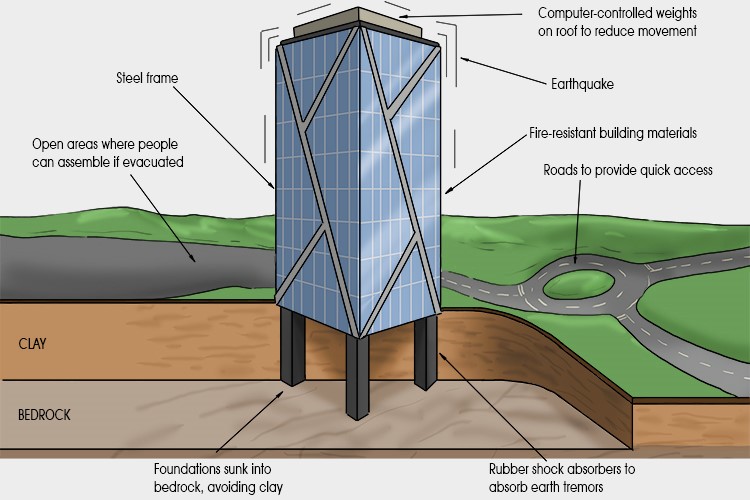
Rubber bearings or sliders placed between the building and foundation absorb motion —
the building shakes less because the ground shakes below it.
e) Energy Dampers
Act like shock absorbers in cars.
They reduce vibration and protect structural components from damage.
3. Foundation & Soil Considerations
✔ Soil Testing (Geotechnical Investigation)
Weak soil = more shaking
Loose sandy soil = risk of liquefaction
Engineers design foundations accordingly.
✔ Foundation Types
-
Raft foundation
-
Pile foundation
-
Mat foundation
All selected based on soil type and seismic zone.
4. Critical Structural Detailing
✔ Beam–Column Joint Strengthening
Most earthquake failures start at the joints.
Proper rebar anchorage, stirrups, and confinement are crucial.
✔ Proper Rebar Spacing & Hooks
Ensures ductility.
Prevents brittle shear failure.
✔ Limiting Large Openings
Windows/doors weaken walls — sizing and placement must follow seismic codes.
✔ Bracing & Wall Continuity
Walls should be aligned vertically and horizontally for better load transfer.
5. Architectural Planning Principles
-
Keep the building shape simple.
-
Avoid unnecessary cantilevers.
-
Distribute mass evenly on each floor.
-
Maintain vertical and horizontal alignment of structural elements.
6. Retrofitting Existing Buildings
Older buildings can be strengthened using:
-
Shear wall addition
-
Steel bracing
-
Jacketing of columns
-
Base-isolation retrofitting in critical buildings
-
Dampers for vibration control
Retrofitting is often cheaper than rebuilding.
7. How Earthquake Loads Travel Through a Building (Simple Explanation)
-
Earthquake shakes the ground.
-
Ground motion hits foundation.
-
Foundation transfers force into columns and shear walls.
-
Columns → beams → floors carry the load upward.
-
Structural system dissipates energy using ductility, framing, and dampers.
This “load path” must be strong and continuous.
Conclusion
Earthquake-resistant building design is not just about stronger materials — it’s about smarter engineering. When load paths are continuous, structural systems are well-chosen, and detailing is precise, buildings can survive even strong quakes.
For professional projects, always follow international codes like ASCE 7, IBC, Eurocode 8, or BNBC (Bangladesh National Building Code).
Created by

Clarity Architects
Who is a good architect? They should be able to listen to their clients and break down complex design concepts in a way that can be easily understood by someone outside of the architectural world. Attention to detail: A good architect has an eye for detail and quality.
Architecture offers several aspects of career flexibility, making it an attractive future career choice: Diverse Specializations: Architects can specialize in various areas such as residential, commercial, healthcare, sustainable design, historic preservation, and more.
Comments (0)
Search
Popular categories
2026 FIFA World Cup
15Home Interior
4Office Design
2Building
2CAD BLOCKS
1Living Room
1Latest blogs

World Cup 2026 Fixtures Download: Full Match Schedule, Printable Calendar & PDF Guide
7 Hours Ago

Top Players in FIFA World Cup 2026: Biggest Stars, Key Performers & Full Football Guide
7 Hours Ago

How to Watch FIFA World Cup 2026 Live: Full Streaming Guide, TV Channels, Apps & Free Viewing Options
7 Hours Ago
Write a public review